In January 2026, claims began circulating on cybercrime-focused platforms alleging that a large dataset linked to Armenian government mailings and notifications had been compromised and offered for sale on underground forums. The reports, which referenced millions of records, quickly raised public concern about a potential breach affecting state communication systems.
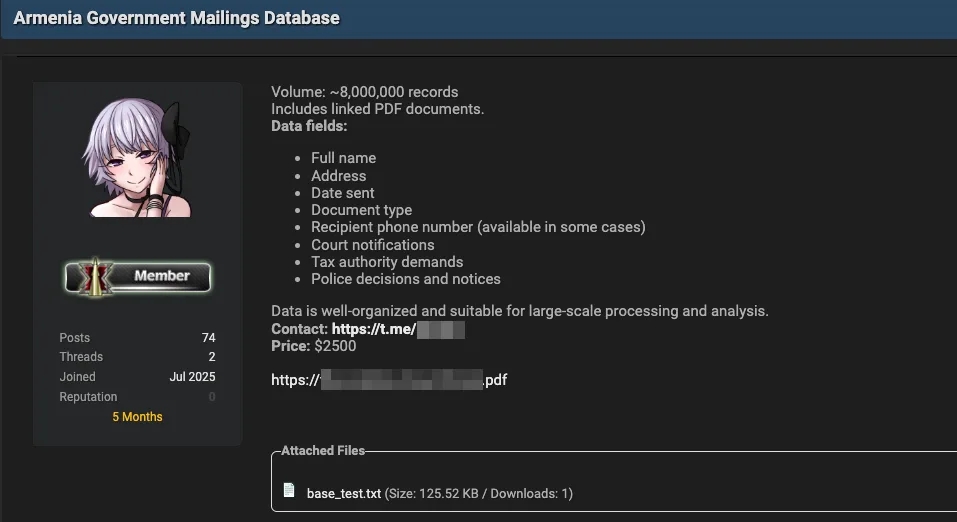
The allegedly compromised data fields include:
- Full names: personal names of citizens and business entities receiving government mail.
- Addresses: physical mailing addresses and regions (e.g., Yerevan, Shirak, Lori).
- Phone numbers: recipient contact numbers, available in some cases.
- Document types: classifications such as court notifications, tax authority demands, and police decisions.
- PDF Content: Actual scanned documents containing sensitive case details, tracking numbers, and official signatures.
- Dates: dates sent and tracking information for registered mail.
In response, the Office of the Prime Minister of Armenia, through its Public Relations and Information Center, issued a formal statement rejecting assertions that the government's electronic mail system had been breached. According to officials, the reported data exposure has no connection to government email infrastructure, and preliminary findings indicate that the files were likely extracted from the cabinet.armlex.am electronic civil proceedings platform. Authorities emphasized that technical work is ongoing to confirm the source of the data and determine the extraction method.
Event chronology
- Claims emerged online regarding the sale of a dataset allegedly linked to Armenian government notifications.
- Armenian authorities publicly denied any breach of the government's electronic mail system.
- Officials stated that the exposed data is not related to government email accounts.
- Preliminary analysis suggests the files originated from the cabinet.armlex.am platform.
- Investigations are ongoing to confirm the findings and clarify technical details.
System and context overview
Armenia's public administration relies on multiple digital platforms designed for distinct purposes. Government email systems are intended for secure internal and official correspondence, while electronic civil proceedings platforms support legal notifications and document handling. Confusing these systems can lead to inaccurate conclusions about incident severity. Understanding which platform a dataset originates from is essential when assessing cybersecurity risk and public impact.
Incident / vulnerability details
The dataset described in online claims was said to include official notices, personal identifiers, and scanned documents. While such information may be sensitive, Armenian officials clarified that there is no evidence of unauthorized access to government email systems. Instead, investigative focus remains on how files associated with civil proceedings may have been accessed, aggregated, or republished without authorization.
Technical analysis
From a cybersecurity standpoint, large datasets advertised on underground forums often consist of information collected over time from multiple sources, including publicly accessible or weakly protected systems. Without forensic evidence of intrusion, exploitation, or compromise, labeling such incidents as confirmed breaches can be misleading. Nevertheless, the circulation of personal data can elevate phishing and impersonation risks, particularly when threat actors leverage the perceived authority of government-related information.
What this means for Users / Organizations
For individuals:
- Exercise caution with unsolicited messages referencing official matters.
- Verify communications through official government portals.
- Avoid sharing personal information in response to unverified messages.
For organizations:
- Communicate investigation results clearly to prevent misinformation.
- Review access controls on civil and administrative platforms.
- Coordinate with data protection and cybersecurity authorities.
Conclusion
Current information does not support claims of a breach involving Armenia's government email systems. Official statements indicate that the alleged data exposure is linked to a separate electronic civil proceedings platform rather than core communication infrastructure. Continued investigation and transparent communication are essential to mitigate secondary risks such as phishing or social engineering.








.png)